
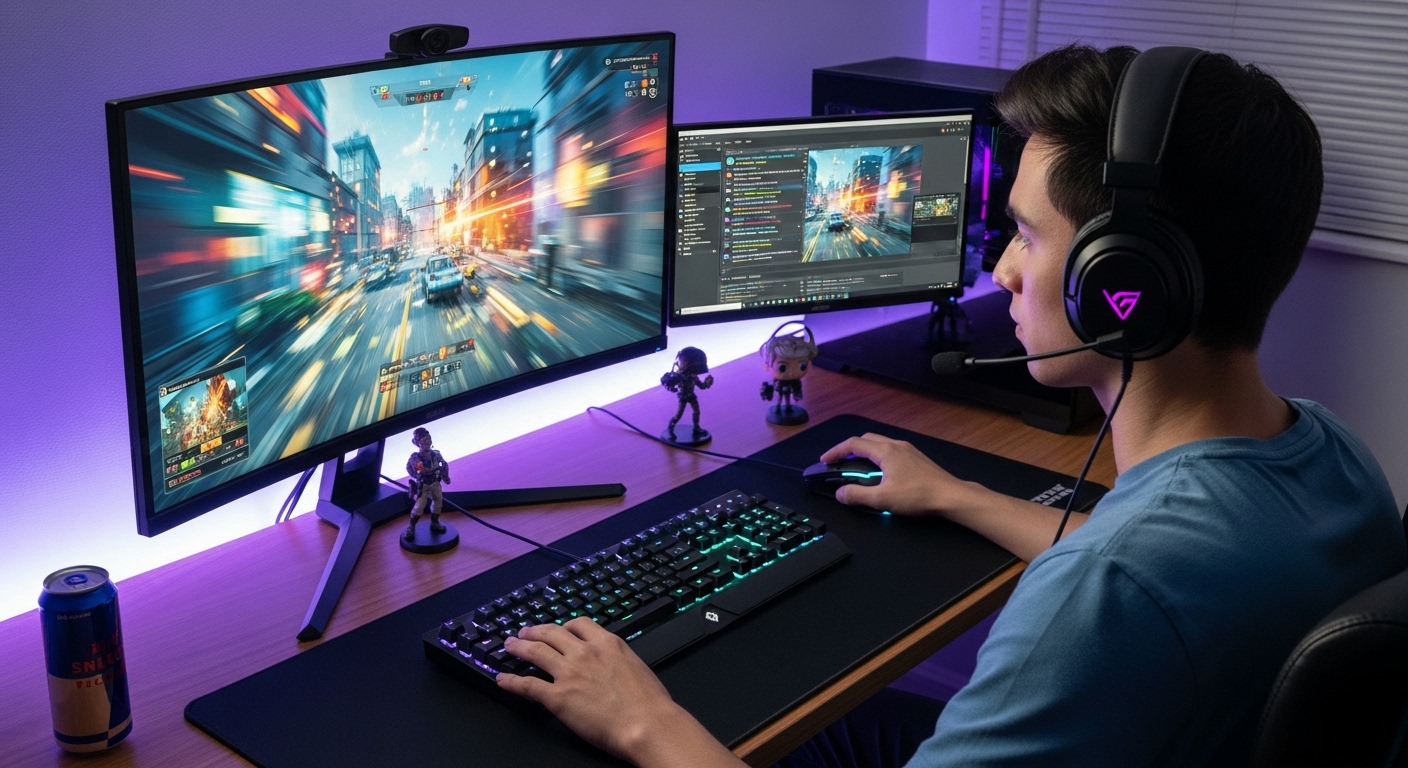
The world of gaming has come a long way since its modest beginnings. From simple pixelated graphics on arcade machines to today’s sprawling virtual worlds with lifelike graphics and complex narratives, gaming has evolved into one of the most influential forms of entertainment in the world. The gaming industry has not only transformed the way we engage with entertainment, but it has also reshaped technology, social dynamics, and cultural trends. This blog post will explore the history of video games, the impact of technological advancements, and the cultural significance of gaming today, while looking ahead to what the future holds.
The Early Beginnings of Video Games
The story of video games begins in the 1940s and 1950s, long before the term “gaming” even existed. The early pioneers of electronic entertainment were mostly scientists and engineers who experimented with ways to engage people through interactive devices. In 1958, physicist William Higinbotham developed Tennis for Two, one of the earliest examples of an interactive electronic game. Displayed on an oscilloscope, it allowed two players to engage in a simple game of tennis, moving paddles back and forth.
In 1962, another groundbreaking development occurred with the release of Spacewar!, created by Steve Russell and others at MIT. Unlike earlier games, Spacewar! was one of the first video games to feature movement and combat in a space environment, and it was played on a digital computer. Its popularity spread to academic institutions, influencing future game designers and laying the groundwork for the future of the industry.
Despite these early achievements, the concept of video games didn’t reach the public in any significant way until the 1970s. The 1972 release of Pong by Atari marked the first commercial success in the video game industry. Pong, a simple two-player table tennis game, was widely popular and became the face of arcade gaming. This success led to the creation of the first arcade game machines, turning video gaming into a mainstream activity.
The Rise of Home Consoles: Bringing Gaming into the Living Room
While arcades were becoming more and more popular, the 1970s and 1980s saw the advent of home gaming consoles. The release of the Atari 2600 in 1977 was a pivotal moment in the history of video games. The Atari 2600 was one of the first consoles to use interchangeable game cartridges, meaning players could purchase different games and play them on the same system. This innovation allowed the home console market to grow quickly, giving families the ability to enjoy video games in their own homes without needing to go to arcades.
The late 1970s and early 1980s were a time of rapid growth in the gaming industry, but this growth also brought about a market crash in 1983. The flood of low-quality games and a lack of innovation led to a decline in consumer interest. Many video game companies went bankrupt, and the future of the gaming industry looked uncertain. However, this was not the end. In 1985, Nintendo introduced the Nintendo Entertainment System (NES), a revolutionary product that revitalized the gaming industry. The NES brought iconic games like Super Mario Bros., The Legend of Zelda, and Metroid into the public consciousness and set a new standard for the quality of video games.
Nintendo’s success inspired other companies to enter the market. In 1988, Sega released the Sega Genesis, and with it came Sonic the Hedgehog, a game that became synonymous with the console. This sparked the beginning of the famous “console wars” between Nintendo and Sega, a rivalry that would dominate the gaming landscape throughout the 1990s.
The Evolution of Graphics: The Transition to 3D Worlds
The 1990s were a defining decade for the gaming industry. This era saw the transition from 2D graphics to fully realized 3D worlds, a change that would forever alter the way games were designed and played. One of the first major technological shifts in this direction came with Sony’s PlayStation, which launched in 1994. The PlayStation allowed developers to create fully 3D environments, taking gaming to new heights. It introduced critically acclaimed titles like Final Fantasy VII, Metal Gear Solid, and Gran Turismo, each of which pushed the boundaries of what was possible in terms of storytelling, graphics, and gameplay.
In the same period, Nintendo released the Nintendo 64 in 1996, bringing its own 3D gaming experiences with titles like Super Mario 64. This game was a revolutionary step forward for platformers, offering players a fully immersive, free-roaming world where they could explore vast 3D environments. The Nintendo 64 and the PlayStation both helped set the stage for the next generation of gaming by introducing the idea that games could be vast, detailed worlds rather than small, linear levels.
The shift to 3D graphics didn’t just impact console gaming; it also had a profound effect on PC gaming. Doom, released in 1993, is often regarded as one of the most influential first-person shooters (FPS) in history. It was one of the first games to feature online multiplayer, enabling players to connect to each other via dial-up internet and engage in virtual battles. Doom and its successors set the stage for an entire genre of FPS games that would dominate the industry for years to come.
The Rise of Online Gaming: Connecting Players Across the Globe
The turn of the 21st century marked the dawn of online gaming, a new era that would forever change the way people played video games. The introduction of broadband internet made it possible for players to connect with one another in real-time, opening up new possibilities for multiplayer gaming. The launch of Xbox Live in 2002 by Microsoft was a key moment in this transition. For the first time, console gamers were able to play against each other over the internet, communicate via voice chat, and participate in online competitions.
Games like Halo 2 were at the forefront of this revolution, offering large-scale multiplayer battles that attracted millions of players. The popularity of online gaming grew rapidly during this time, and services like PlayStation Network (PSN) and Steam (on PC) soon followed, allowing players to access games, downloadable content, and online features from their consoles or PCs.
One of the most important developments in online gaming during this time was the rise of Massively Multiplayer Online Games (MMOs). These games, such as World of Warcraft (released in 2004), offered players the opportunity to interact with thousands of other people in persistent, evolving virtual worlds. World of Warcraft became a cultural phenomenon, attracting millions of players and setting the stage for the future of online gaming. MMOs opened up new avenues for social interaction and cooperative play, where players could join guilds, take part in quests, and engage in large-scale PvP (player versus player) battles.
Mobile Gaming: The Smartphone Revolution
In the 2000s and 2010s, mobile gaming emerged as a major force in the industry. The advent of smartphones and tablets made it possible for people to carry games with them wherever they went. Mobile gaming has become one of the largest sectors of the gaming industry, and games like Angry Birds, Candy Crush Saga, and Clash of Clans have become household names.
The appeal of mobile gaming lies in its accessibility and simplicity. Many mobile games are free to play or offer low-cost entry points, making them accessible to a wide audience. Casual gamers, people who don’t consider themselves dedicated players, make up a large portion of the mobile gaming market. The rise of “freemium” games, where players can download and play the game for free but can purchase in-game items or advantages, has contributed to the rapid growth of mobile gaming.
Moreover, mobile gaming introduced augmented reality (AR) games, the most famous of which is Pokémon GO. Released in 2016, Pokémon GO combined real-world exploration with virtual gameplay, allowing players to capture Pokémon in their local neighborhoods by using their phone’s GPS and camera. This innovative game became a global phenomenon and demonstrated the potential of AR technology in gaming.
Virtual Reality: Immersing Players in Digital Worlds
As technology continues to advance, virtual reality (VR) has become one of the most exciting frontiers in the gaming industry. VR offers players a fully immersive experience by placing them inside a digital world, where they can interact with objects and environments as though they were real. The development of VR headsets, such as the Oculus Rift, HTC Vive, and PlayStation VR, has made it possible for gamers to experience games in ways that were previously unimaginable.
VR gaming offers a level of immersion that traditional gaming cannot match. Players are no longer limited to a screen in front of them; instead, they can look around and interact with the virtual environment in three dimensions. Games like Beat Saber and Half-Life: Alyx have demonstrated the incredible potential of VR gaming, and the technology is only improving as time goes on.
While VR gaming is still in its early stages, it has the potential to revolutionize the entire industry. As the technology improves and becomes more affordable, we may see more and more games adopting VR as a standard platform. Additionally, as VR headsets become more comfortable and accessible, gaming could become even more immersive and social, with players interacting with one another in virtual spaces in ways that we have yet to fully imagine.
The Cultural Impact of Gaming
Gaming has become more than just a form of entertainment; it has become a cultural force. The rise of esports has turned video gaming into a competitive spectator sport, with professional players and teams competing for huge prizes in tournaments watched by millions. Games like League of Legends, Fortnite, and Dota 2 have established massive esports scenes, and gaming events now fill stadiums, with live streams attracting millions of viewers worldwide.
In addition to esports, gaming has become a powerful platform for storytelling. Modern video games offer deep narratives, well-developed characters, and complex worlds that rival those of films and television. Games like The Last of Us, Red Dead Redemption 2, and The Witcher 3 have shown that video games can offer emotional depth and sophisticated themes, sparking conversations about the power of interactive media as a storytelling tool.
Moreover, gaming has become an increasingly social activity. Online multiplayer games, social networks, and streaming platforms like Twitch have allowed people to connect and build communities around their favorite games. People now gather to watch others play, interact with gamers in real time, and discuss strategies, lore, and game culture.
The Future of Gaming: What Lies Ahead?
The future of gaming looks incredibly exciting. As technology continues to evolve, we can expect further advancements in gaming hardware, from more powerful consoles to cutting-edge VR headsets. Artificial intelligence (AI) will play a significant role in creating more dynamic, responsive game worlds. We can also expect improvements in cloud gaming, where players can stream games directly to their devices without the need for expensive hardware.
As gaming technology continues to improve, we may see even more immersive experiences, allowing players to interact with virtual worlds in ways that were once only imagined. The rise of AI and machine learning could also lead to more sophisticated and adaptive gameplay, making each gaming session unique.
One thing is clear: gaming is not just a passing trend—it is a deeply ingrained part of modern culture and entertainment. The gaming industry will continue to evolve and shape our technological and social landscapes, offering new ways to experience, interact with, and enjoy digital worlds.
Conclusion
The journey of video games from their humble beginnings to their present-day dominance is nothing short of remarkable. What started as a niche form of entertainment has grown into a multi-billion-dollar industry that impacts nearly every aspect of modern life. Gaming has revolutionized technology, changed the way we interact with one another, and provided new platforms for creativity and storytelling.
As we look to the future, there is no telling where gaming will take us next. With advances in virtual reality, cloud gaming, artificial intelligence, and online connectivity, the next era of gaming promises to be even more immersive and innovative. The world of gaming is always evolving, and as players, developers, and fans, we are all along for the ride.